Muscat Municipality Central Laboratory... Efforts and challenges
• The laboratory examines different food samples, so that the municipality monitors the nutritional status and maintain the safety of the consumer and eventually the health of the community.
• The total amount of the microbilogical inspection to the end of the third quarter of the last year was up to (671 food samples)
• During the current period, a study of the quality of the industrial ice used for cooling juices and beverages in Muscat Governorate and a preliminary assessment of the quality of ice cubes in other food facilities are being prepared.
By: Anisa Al-Oufiya
Consumer health is a priority for Muscat municipality. It carefully assess the quality and safety of food traded in the markets and conducts some necessary laboratory testing using methods that are approved globally.
The municipality laboratory is an interface for health services and the front line for health and safety of food, as it analises and examines food samples. The Laboratory analyses of chemical and microbiological tests are carried out in accordance with approved local and global standards. This procedure will maintain a very low risk of food contamination, at the same time the laboratory department is making intensive efforts and continuous development of analysis areas by providing the latest and best analytical techniques and instrumentation that are competent to accurately test results, conduct surveys and keep abreast of industrial developments.
The laboratory specialism
The Central Laboratory is responsible for conducting laboratory tests for food and water offered in Muscat Governorate markets, as well as coordination with other laboratories on results and more affirmative tests on food products, studies, research and product surveys. , with attention to the work of inspectors ` courses in the withdrawal and examination of food samples, as well as the practical coordination of the training of university and college students special technicians in the field of laboratory testing, development of laboratory tests in line with modern technologies and seeking accreditation for the laboratory Laboratory tests as well as coordination with the inspection and food control sections of Muscat municipality on the laboratory programme of work and follow-up on the results of the tests.
Challenges
Despite the support the Central laboratory is having, the broad opening to all countries of the world and the heavy dependence on imports From various countries of the world of fresh, frozen and manufactured animal and vegetable foodstuffs has produced some challenges in the area of food safety control. Furthermore, majority of foodstuffs of animal meat, birds and plant have been manufactured with additives.
Importance of the Central laboratory
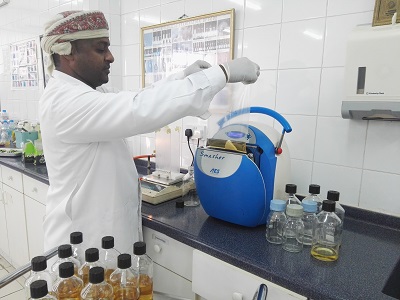
The importance of the Municipality Lab stems from the the preventive role of food safety and public health as it comes before the therapeutic role. The technical staff of laboratory specialists and municipal inspectors are undoubtedly an important and influential role in achieving the best services that relate to the public health aspect to which all members of society aspire, both in terms of nutrition safety and public health maintenance, as the municipality Muscat in accordance with the legislation and laws promulgated by it has the right and competence to control, inspect, seize, confiscate and dispose of materials food that is harmful to the health and safety of human and unfit for human consumption this is a priority for the Central laboratory in view of its own High technology to perform their assigned tasks:
• Microbial Analysis Unit:
1. Initial rapid detection device.
2. The microbial type verification device, which assists in the rapid and accurate diagnosis of the causes of the food contamination and the precise identification of the microbial type.
3-Automatic total count device.
4. DNA PCR.
5. Fungal toxin screening system.
• Chemical Analysis Unit:
Part of what this unit doing is separating many different compounds, analyzing their components and determining their mass, as well as digesting and estimating elements, and we can identify the types components, either through (ultraviolet/infrared/optical) and identification of component components of vehicles of membership. This unit does the necessary analyses of foodstuffs, such as the analysis of samples of wells, vegetables, fruits and liquid substances, such as juices and beverages, the most important of these are the Chemical Analysis section:
1. Chemical separation Devices: the separation of many different chemical compounds, where the components of the sample are separated and then recognized and valued where the specimen is separated by the distribution of the sample between two different stages and includes the following organs:
1. The gas chromatographic device of the mass Spectrometer (GC-MS)
2. Chromatographic fluid separation device under high pressure (HPLC)
2. Element estimation device: These methods depend on the absorption of the substance (in the atomic or molecular situation) of part of the Rays on it:
1- Metal elements estimation device by plasma emission (ICP)
The chromatographic analysis and separation device is the most accurate and quickest modern method of separating and analyzing samples and the device-operated software has multiple capabilities to obtain the results as required by the researcher.
Research and studies conducted in the laboratory:
During the current period, a study entitled (Study of the quality of ice manufactured in ice plants used to cool juices and beverages in Muscat Governorate and evaluation) is being prepared first for the quality of ice cubes in other food facilities), as has been prepared a survey to verify the presence of aflatoxine toxins in nuts Raw and hand-packed and displayed in shops in Muscat Governorate.
Laboratory tests:
1. The micrpbilogical inspection of foodstuff until the third quarter of 2017:
• The number of samples conforming the microbiological specifications was (652).
• The number of samples not conform to the microbiological specifications of food was (19).
• The total number of foodstuff samples was (671)
2. Chemical screening of foodstuff:
• The number of samples conforming to the chemical specifications for food was set at (45).
• The number of samples did not conform to the chemical specifications for food was (9).
• A total of 54 food samples were investigated.
Efforts and coherence
For the interconnection of government institutions in the Sultanate in general, there is deep coordination and cooperation between the Central laboratory in Muscat municipality and health institutions on the one hand and laboratories of others, on the other hand, is important for activating all capacities, especially government agencies, promoting their work and raising competencies By exchanging experiences and techniques in general, inter-laboratory cooperation means working together to reach healthy foods and combat all nurses.